
The crema: useful or essential?
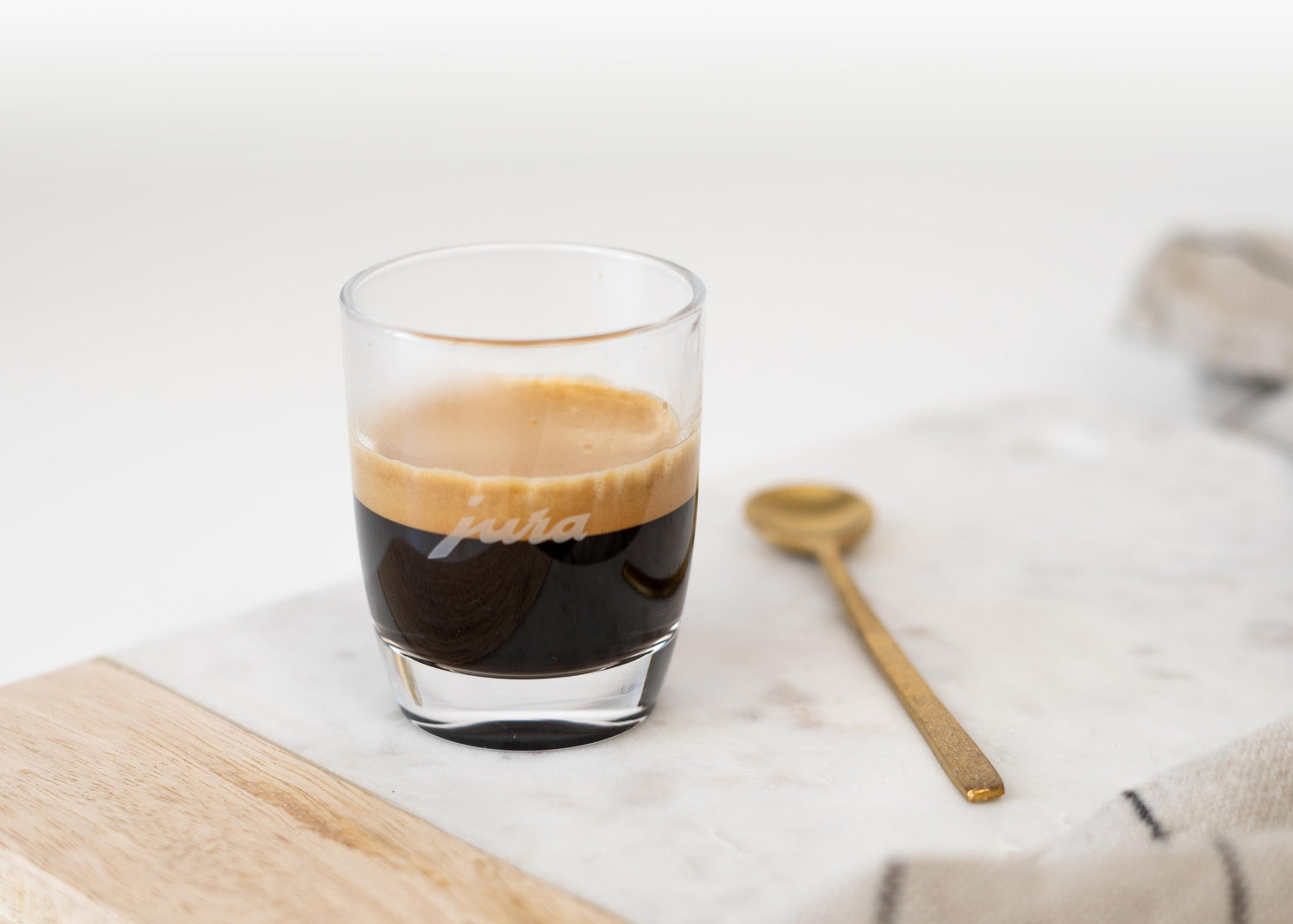
Almost everything has been said and written about crema. But what is it exactly? To answer that, let's start with what it really is.
Visually, you could describe it as a dense, relatively thick foam whose colour ranges from golden beige to light brown. Translated literally, the word crema comes from the Italian for "cream," referring to the fatty part of milk. But beyond its glossy surface, crema has nothing to do with cream. This mysterious layer worth its weight in gold is far more complex than it appears.
A short history of espresso
It was Giovanni Achille Gaggia, in the 1940s, who truly invented the machine capable of producing modern espresso. Until then, the drink had been more like a quick filter coffee brewed in very little time. To set his version apart, Gaggia decided to call it "Caffè Crema" a fitting name once you've seen the texture of an espresso. To learn more about the birth of espresso, we recommend James Hoffmann's excellent video on the subject.
The chemistry of crema
If you enjoy filter coffee, you're familiar with the concept of "blooming", that first stage of brewing where the grounds swell as CO₂ is released on contact with hot water. As a reminder, this CO₂ is the result of the Maillard reactions, the interaction between proteins and sugars during roasting. In an espresso machine, however, there's no room for CO₂ to escape the portafilter. Crema, then, is simply the result of a forced "blooming" under pressure during extraction.
But that's not the whole story. Carbon dioxide and water vapour aren't the only things being pressurized inside the portafilter. In Les 101 mots du café, Christophe Lavelle explains that droplets of oil and solid particles are also extracted. What we're really looking at, then, is an emulsion in which fats and hydrophobic compounds cluster together and trap bubbles of CO₂ gas.
That answers our first question: yes, it's the crema. But is it actually useful, or is it essential to a good espresso?
As you probably know, coffee is best enjoyed as close as possible to its roast date. Over time, coffee loses both its organoleptic qualities and its CO₂. We can therefore imagine that the quality of the crema gives us a useful way to assess a coffee's freshness.
That said, other factors also influence both the appearance and the flavour of the crema:
-
A grind that's too coarse and/or a brewing temperature that's too low: this lets more CO₂ and more water, escape, producing a generous crema but a body that's too thin.
-
A grind that's too fine and/or a temperature that's too high: the opposite happens. You get a thin crema with little structure and a bitter, unbalanced taste.
In conclusion
Crema is therefore a useful visual indicator for understanding, learning about, and improving your espresso. It also offers undeniable aesthetic and practical benefits:
-
It provides a contrast with the dark liquid below, making espresso the unique and iconic drink it is.
-
It helps preserve the aromas and temperature of the drink while you enjoy it.
-
It pairs perfectly with milk foam to create latte art and deliver a smooth, aromatic first sip.
